
Fashion Design · Cheng's ELYTRA
Fashion Design Process: Cheng’s ELYTRA Beetle Collection
Original fashion design by Cheng. Editorial interpretation by the GoVoloom Editorial Team.
Cheng’s ELYTRA collection turns beetle-inspired enclosure, segmentation and unfolding into four distinct womenswear silhouettes. Its working title, 鞘光 / ELYTRA, connects a rounded cropped jacket, a layered-waist trouser look, an asymmetric dress and a long gown with sculptural back panels.
The design package brings together inspiration, front-and-back studies, structural notes and candidate materials. Fabric selection, pattern cutting and fitting are the next steps.
The designs are shown with permission for this editorial presentation. Commercial use requires Cheng’s prior written consent.
1. Inspiration sources: beetle form and fashion structure
The natural references in the dossier focus on four relationships: a closed, rounded outer form; repeated segments; surfaces overlapping as they separate; and an outer casing opening around lighter inner layers. Each offers a different design question. Where should a garment hold volume? Where can a curve repeat? Which layer covers another, and where does the silhouette open?
These observations become the vocabulary of the collection: domed shoulders, curved divisions, layered edges and a volume that expands behind the body. The beetle reference is carried through the garment’s shape and its inner–outer relationship.
The dossier also records research into historical clothing construction. Relevant references include:
- Cristóbal Balenciaga’s 1963 coat at the Kyoto Costume Institute, whose rounded shoulder and integrated volume provide a reference for the first look’s enclosed upper-body shape.
- Thierry Mugler’s Spring/Summer 1990 jacket, the central piece in KCI’s record, included in the research on shaped waistlines and articulated surface divisions for the second look.
- Charles James’s 1951 evening dress at The Metropolitan Museum of Art, a reference for the third look’s asymmetry and curved, overlapping organization.
- Charles James’s Butterfly, circa 1955, at The Met, included in the fourth look’s study of a close body and expansive rear volume.
These historical works retain their own authorship. In this study, the dossier connects particular formal observations to Cheng’s four designs: rounded enclosure becomes a cropped jacket and skirt; segmentation concentrates at the waist; overlap shifts across the hips; unfolding becomes a back-focused gown. The museum links identify the research references; the illustrations on this page present Cheng’s collection.
2. Design thinking: one progression, four points of emphasis
The dossier names its central direction as “from enclosure to unfolding.” That progression gives the series an order while allowing every look to have its own silhouette. The visual focus moves from the shoulders and upper body in Look 01, to the waist in Look 02, across the waist and hips in Look 03, and outward from the back in Look 04.
The palette holds those changes together. Ink black provides the continuous base and quiet lower areas. Metallic green carries much of the rounded, segmented or overlapping outer form. Blue-violet appears in smaller inner sections, becoming more visible where the structure opens. These are design color directions; the final fabric references still need to be selected.
Coherence comes from repeating relationships: curved outer shapes over a calmer foundation, a controlled dark base beside a reflective-looking green surface, and a small contrasting glimpse within the layers. The series can change garment category and proportion while retaining those relationships.
3. Expressive idea: a form that gradually opens
The collection can be read as a movement from containment towards openness. The first look holds its strongest volume close to the shoulders. Later looks reveal more independent layers, until the final gown projects its largest form behind the wearer.
The contrast between an enclosing outside and a lighter inside gives that progression its visual tension. Black keeps a legible foundation beneath the green forms, while small blue-violet passages suggest another layer emerging. The expression is carried by where volume sits, how edges overlap and how much of the inner structure is revealed.
Seen as a group, the four looks explore degrees of opening. Their shared idea remains visible even though the first two are separates and the later two are dresses. That is the useful design lesson here: a collection’s theme can operate through a relationship between forms across several garments.
4. From color studies to structural decisions
The paired color studies and line drawings make different parts of the idea readable. Color establishes the balance of surfaces and layers. Line drawings help locate edges, openings and the relationship between front and back. The v3 notes settle some ambiguous marks and leave other questions for pattern development.
Look 01: hold the volume around the shoulders
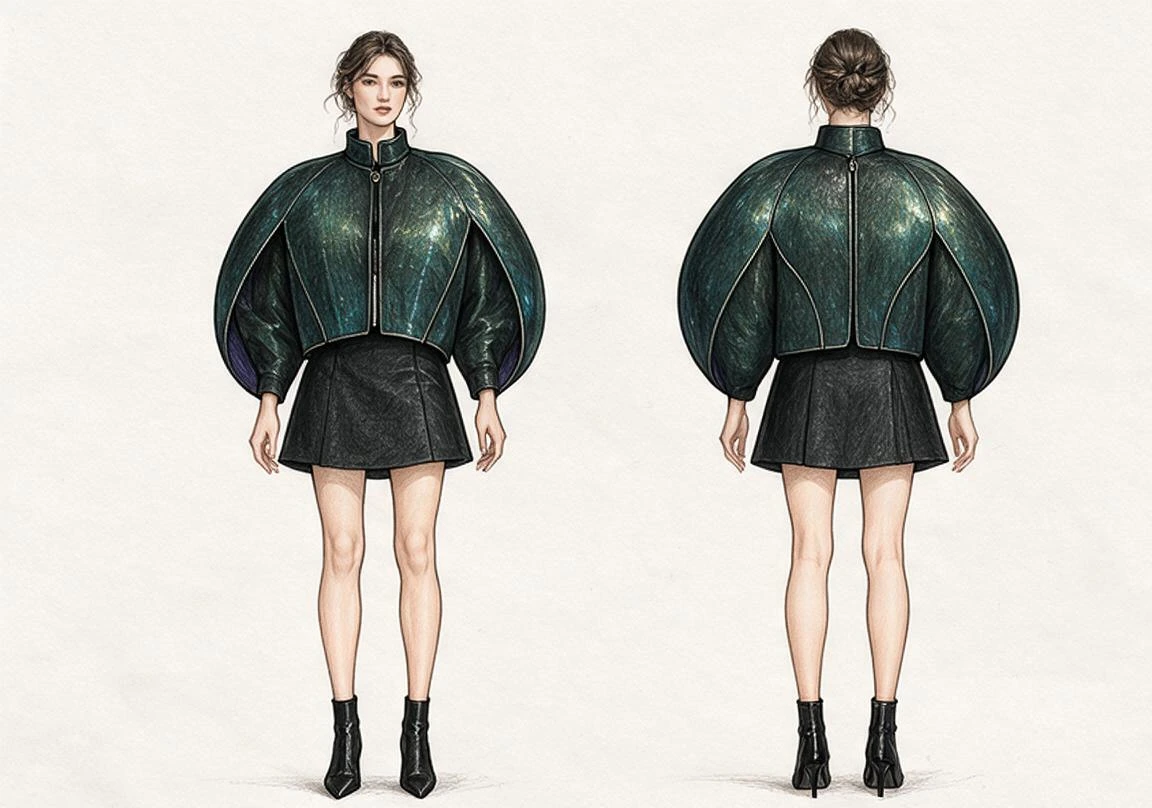
The opening color study shows the collection’s most enclosed silhouette: a rounded, cropped jacket over a clean A-line miniskirt. Its high collar, domed shoulder-and-sleeve shape and slightly drawn-in jacket hem concentrate the form around the upper body. The skirt gives that volume a clear lower boundary.
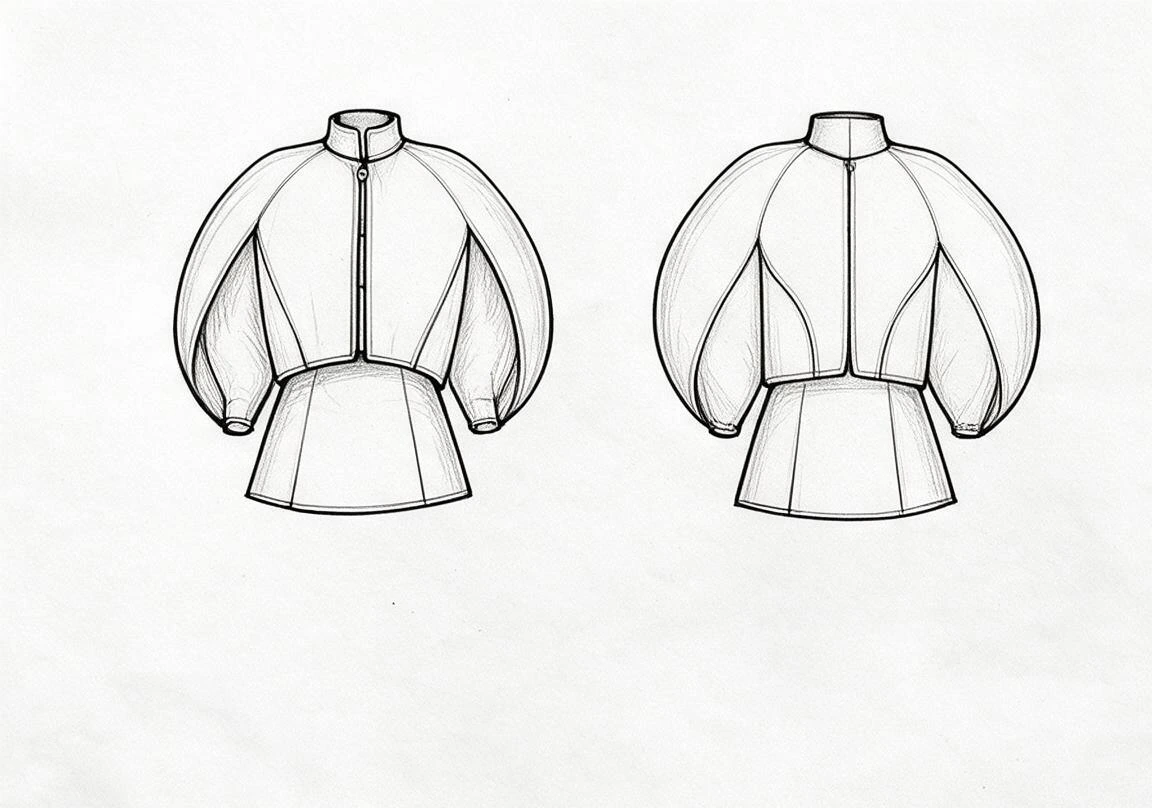
Read the back drawing with the v3 correction: the zipper-like mark at the jacket’s center back is not adopted. The intended center back is a seam; the jacket opens at the center front. The original drawing has been retained, so this written correction is part of the design information. Collar comfort, arm movement and the stability of the rounded shoulder still need physical development.
Look 02: move the rhythm to the waist
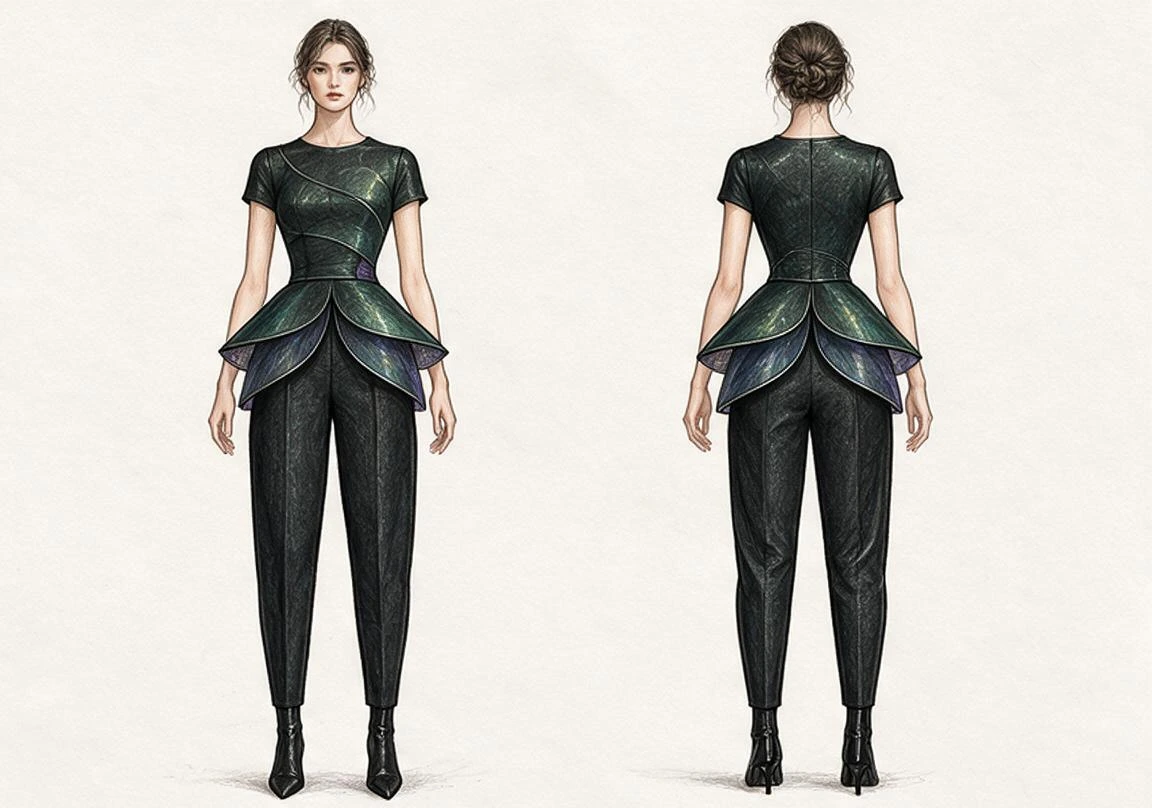
The second look fixes a short-sleeved, fitted-waist top above high-waisted tapered trousers. Curved layers spread from the waist while the trouser legs narrow downward. Segmentation becomes a repeated edge and a change in proportion, with the main activity held at the center of the silhouette.
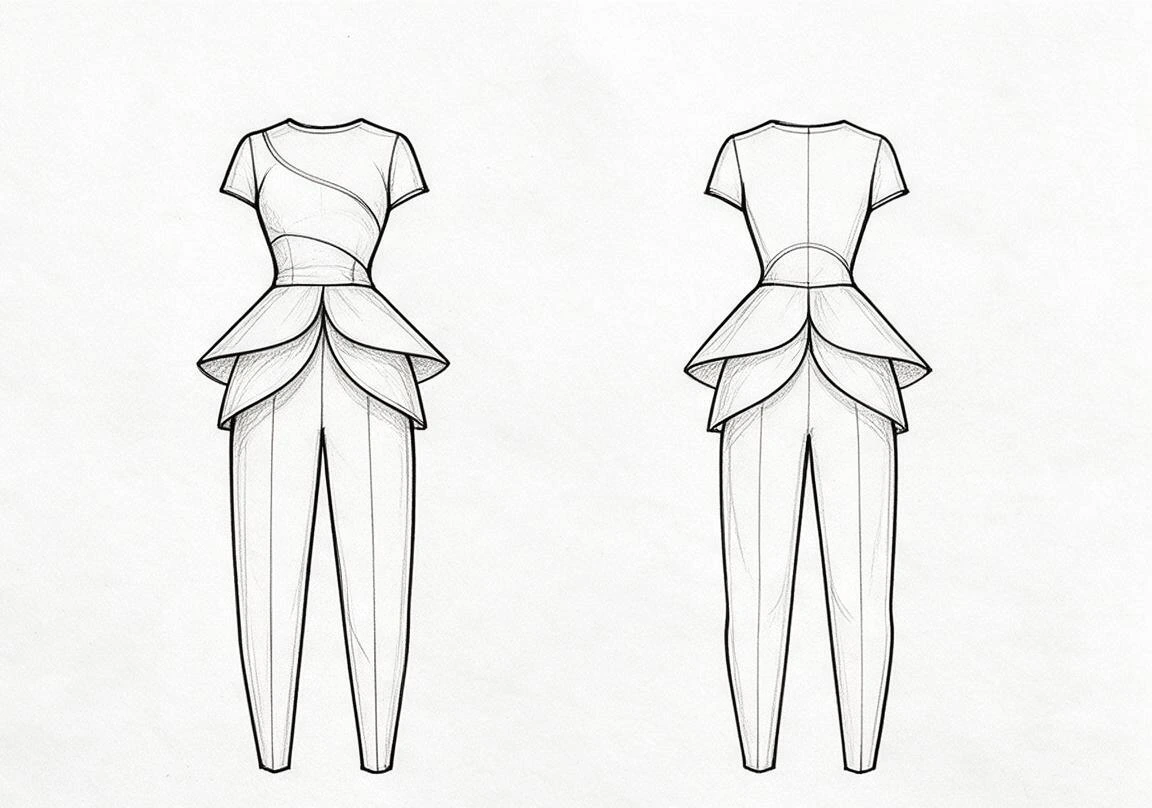
The line study needs a careful reading: a layer’s outer edge, a seam and a highlight are different kinds of information. The design notes call for the principal waist lines and layers to connect around the side seams. Final piece counts and seam allowances remain for the pattern stage; sitting and dressing will reveal whether the layered waist can keep its intended form comfortably. The panel-mapping guide explains how to separate a visible boundary from its proposed construction.
Look 03: let overlap travel across the body
The third look combines a one-shoulder neckline with offset green layers over a continuous, opaque black foundation dress. The overlap travels around the waist and hips towards the side and back, giving the silhouette a direction without adding a new set of layers to the approved design.
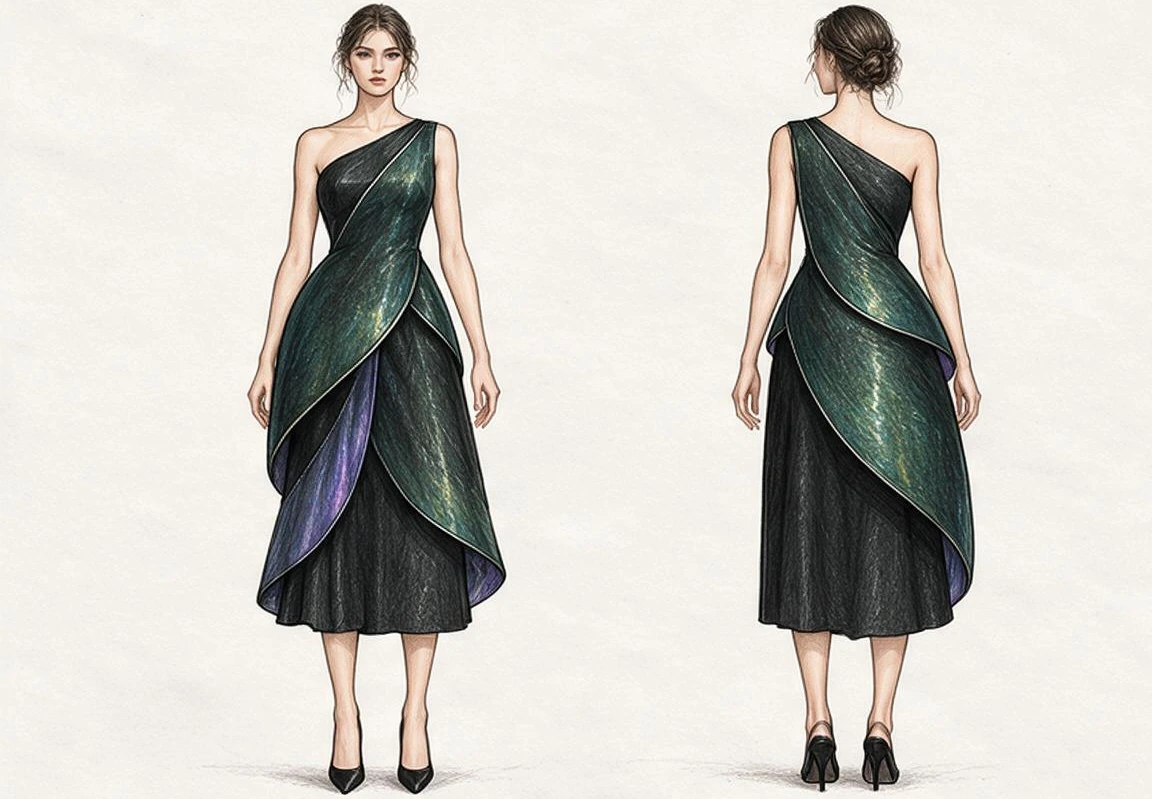
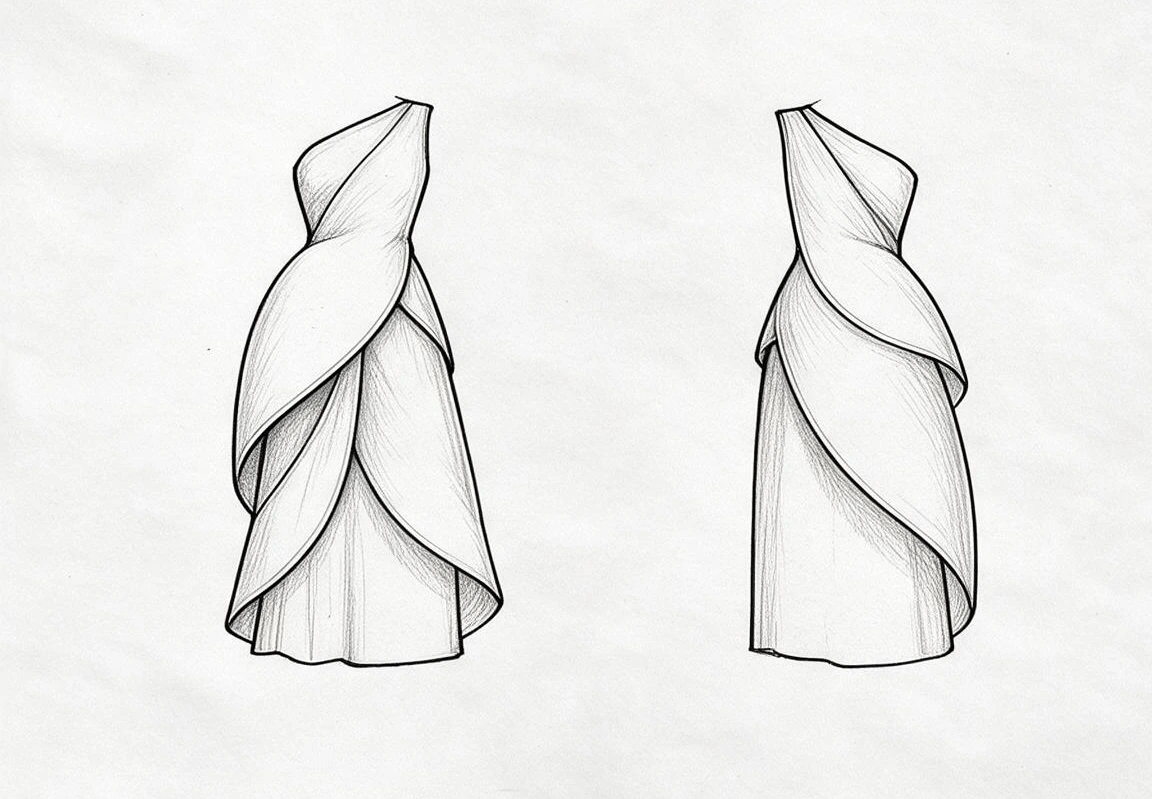
The covered shoulder remains the wearer’s left shoulder in both views. Its position on the page changes when the body is seen from behind. The dossier proposes an opening at the wearer’s right side, away from the main overlay attachments. A partial waist-and-hip sample is planned to examine the overlap, coverage and pull between the outer layers and the foundation during movement.
Look 04: release the volume at the back
The final look keeps a long gown with a square neckline and straps, then gives the back two rounded outer panels with a small amount of blue-violet inner folding. The front offers a restrained outline with glimpses of the outer edges; the back carries the expanded form.
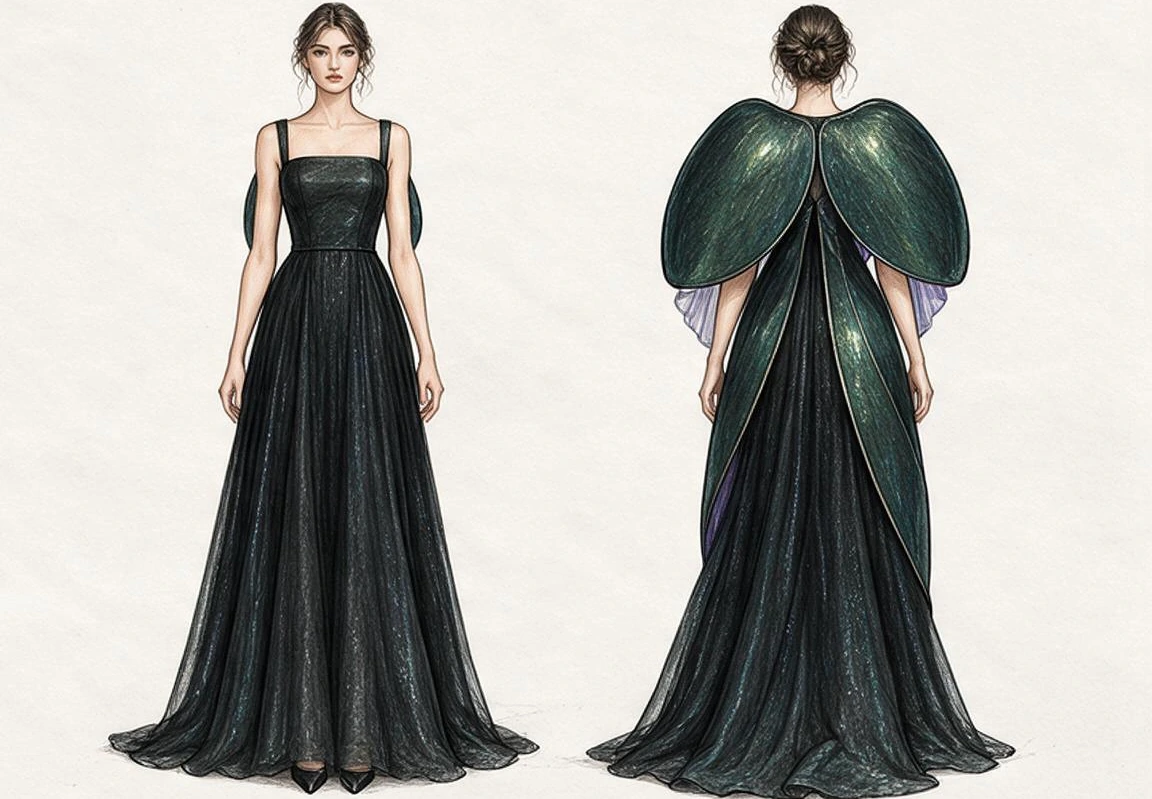
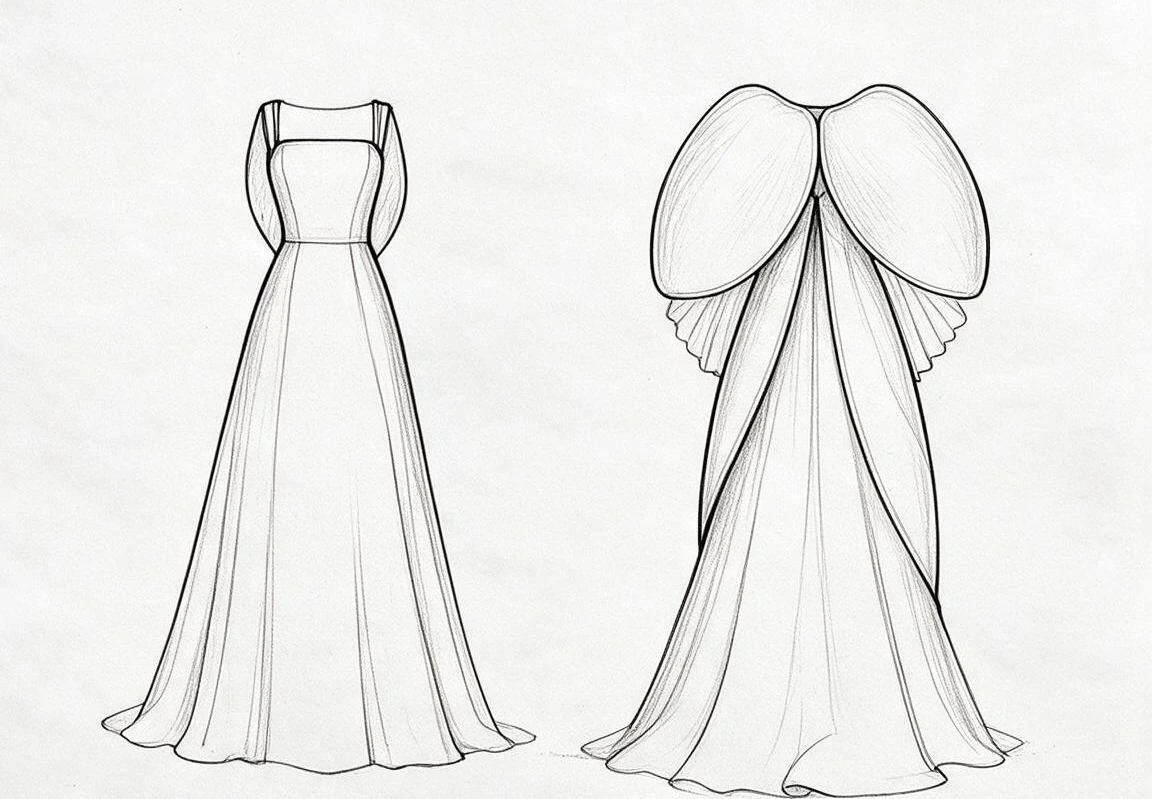
The v3 view labels identify the front on the left and the back on the right, correcting an earlier label. The design proposal directs the load towards a stable inner bodice and waist, with a detachable arrangement still under study. The attachment, support and dressing sequence need a physical trial; the drawing alone does not establish how the back structure will behave.
5. Let each material serve its part of the design
The material plan follows the role of each layer. The rounded jacket needs a fabric and supporting treatment that can hold its upper-body volume while allowing movement. The overlapping dress needs a continuous foundation with coverage and drape, together with outer pieces that retain a readable edge. The gown’s back panels introduce a different question: how to create volume with controlled weight.
For the green outer forms, the proposed comparisons include taffeta, satin and closely woven fabrics with some body. The black directions divide between more structured skirt or trouser materials and more fluid foundations for the dresses. Organza and chiffon are candidates for the lighter blue-violet layers. For the final gown, the plan considers light, crisp fabrics, layered organza and local support for the expanded back.
These are candidate directions, not selected fabric specifications. Their value is in making the design questions concrete: how does a curved edge sit, how thick does an overlap become, and does attaching an outer panel pull the foundation out of shape? The same color can recur through the collection while the fabric’s role changes.
Once actual materials are chosen, the technical-pack structure can connect their references with the drawings and measured specifications. That record should preserve the distinction between a surface that looks lustrous in a design study and the behavior of the fabric selected for the garment.
6. Carry the idea into physical development
The next development sequence recorded in v3 starts with Look 03’s waist-and-hip overlap and Look 04’s back structure, followed by Look 01’s rounded shoulder and Look 02’s layered waist. Each partial sample would bring a different part of the collection’s expression into contact with real fabric and movement.
For Look 03, the questions concern the layering order, coverage, walking and sitting. For Look 04, the review needs to examine the back panels’ own weight, their connection to the inner garment and the effect of turning, sitting and dressing. The jacket’s curved volume needs to be checked during arm movement; the layered waist needs to be observed when the wearer sits.
Record what changes in the form as those questions are resolved. A lighter support might preserve the open back silhouette more effectively, or a revised attachment might alter the way an overlapping edge falls. Those are possibilities for development to investigate. The sample-review process provides a place to connect the observation, proposed change and next version.
ELYTRA’s design package is complete as a collection study: four fixed looks, paired front-and-back views, structural proposals, material directions and a development plan. Final measurements, patterns, selected fabrics and fitting results remain to be established. Its design process is visible in the connection between an idea and the specific decisions that carry it—from a closed, rounded form to an expanded back silhouette.
For readers shaping their own original collection, the moodboard-to-sample guide offers a broader framework for connecting color, silhouette and detail to development.
Original fashion design by Cheng. Commercial use requires Cheng’s prior written consent. This editorial display does not grant permission to copy, adapt or order these designs for commercial use.
