
Decoration Techniques / Sublimation Printing
Sublimation Printing for Custom Apparel
Colour that becomes part of the fabric itself: unlimited colours, photographic detail, zero handfeel, and prints that never crack or peel. The catch — it only works on white or light polyester. We verify your fabric before a single panel is printed.
Overview
One Design. Several Layers.
Sublimation dyes the fibres rather than coating them. That one fact drives every design, fabric and cost decision.
Artwork
Unlimited colours, gradients and photographic detail are all free. Raster artwork at 150dpi+ at final size is ideal.
Quantity
No screens, so small runs are economical. All-over prints are priced per panel regardless of colour count.
Surface
Polyester only, and white or very light colours only. Cotton does not take the dye; dark fabrics hide it.
Result
Zero handfeel — the print is inside the fibre. Nothing to crack, peel or fade, even under heavy washing.
Suitability
Is This a Sublimation Printing Job?
Sublimation is the natural route for performance wear — and the wrong route for most cotton basics.
Sportswear & Activewear
The definitive use case: polyester jerseys, leggings, rash guards and team wear with all-over prints.
Performance T-Shirts
Excellent on white polyester tees. Polyester-cotton blends lose vibrancy in proportion to cotton content.
Leggings & Compression
Prints stretch with the fabric without cracking — something no surface print can do. White base fabric required.
Cotton & Dark Garments
Not viable. The dye bonds only with polyester and shows only on light grounds — we will suggest screen or digital printing instead.
How It Works
How Sublimation Printing Behaves on Fabric
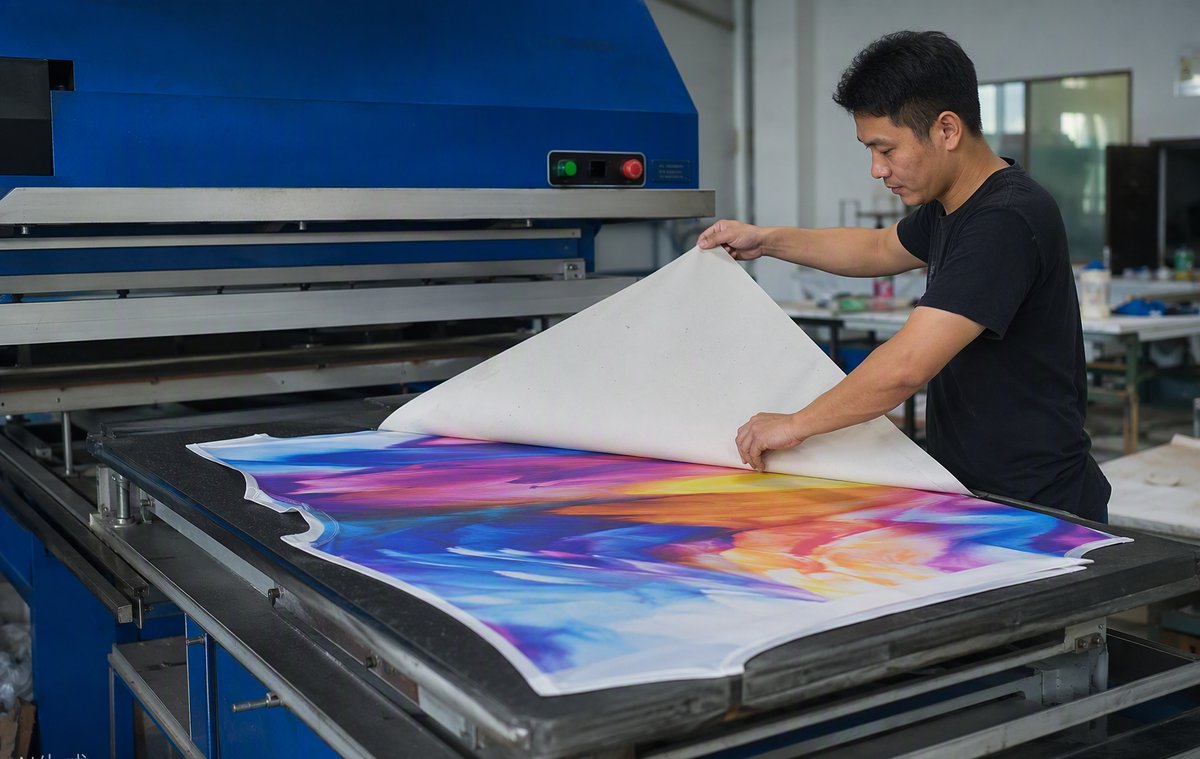
Printed transfer paper meets polyester under heat and pressure. The ink turns to gas and enters the fibre permanently.
White Base Rule
There is no white sublimation ink. Any white in your design is the fabric showing through — so the garment must start white or very light.
Panel Printing
All-over designs are printed on cut panels before sewing. This gives edge-to-edge coverage that printing on finished garments cannot achieve.
Materials
Choose Materials After the Fabric
Fabric choice is the material decision. Everything else follows.
100% Polyester
Full vibrancy. Interlock, mesh, piqué and performance knits all sublimate well when white.
Poly-Spandex
The activewear standard. Prints stay intact through stretch; whites must be optical white for clean colours.
Poly-Cotton Blends
Partial bonding produces a vintage, faded look by definition — sometimes used deliberately, but never a way to get vivid colour.
Process
From File to Finish
From digital file to dyed panel — colour is managed with ICC profiles, not eyeballing.
Review
Artwork resolution, fabric composition and garment colour are confirmed — the three things sublimation cannot forgive.
Colour Setup
ICC profiles for the specific printer, ink and fabric are applied. Screen colour is a rough guide only.
Print Transfer
The design is printed in mirror image onto sublimation transfer paper.
Press
Paper meets fabric at ~200°C under pressure. The ink gases and bonds into the polyester.
Panel Check
All-over jobs are checked panel by panel for colour, registration and ghosting before sewing.
Sew
Printed panels are cut and constructed into garments with print-matched seams.
Inspect
Colour against the approved sample, seam matching and white-crease checks per batch.
Pricing
What Changes the Quote
No screens, no colour limits — the quote moves on fabric and coverage instead.
Coverage
A chest logo on a white tee is cheap. All-over panel printing uses more paper, ink and pressing time per garment.
Fabric
The white polyester base is part of the quote. Specialty performance knits cost more than standard interlock.
Construction
All-over sublimation is sewn from printed panels — a different production route than printing on ready garments, priced accordingly.
Quality Control
What a Failed Print Looks Like
We inspect against these known failure modes — agreed before production.
Ghosting
A faint double image from paper shifting during pressing. Paper is fixed and press pressure verified per run.
White Creases
Unprinted white lines where fabric was folded in the press. Panels are pressed flat with crease checks before sewing.
Colour Shift
Output drifts from the approved sample. ICC profiles and press temperature are logged per batch.
Dull Blacks
Weak, brownish blacks from under-pressing or low polyester content. Verified on the strike-off, not in bulk.
Side Seam Mismatch
All-over patterns that do not align at seams. Pattern engineering and panel mapping are checked at sampling.
Moisture Wicking Loss
Heavy ink coverage can reduce breathability. Coverage is reviewed against the garment’s performance purpose.
Sampling
Approve the Physical Result
Colour on screen means nothing in sublimation. The pressed fabric sample is the standard.
Artwork Approval
You confirm layout, scale and placement on a digital mockup.
Fabric Strike-Off
A pressed sample on the actual white polyester checks colour, blacks and vibrancy.
Pre-Production Garment
A complete sewn garment confirms seam matching and all-over layout.
Bulk Checks
Panel-level checks during pressing, garment-level checks after sewing.
Decision Boundary
Sublimation Printing or Another Route?
Three ways to get full-colour artwork onto a garment — pick by fabric first.
Sublimation
Dye inside the fibre, unlimited colour, zero handfeel.
Best for: White polyester sportswear and all-over prints
Digital Printing (DTG)
Ink on the surface, any colour count, works on cotton.
Best for: Full-colour art on cotton tees at small runs
Screen Printing
Flat spot colours, the boldest opacity.
Best for: Limited-colour graphics at quantity
FAQ
Questions Before Sampling
Can you sublimate on cotton?
No — sublimation dye bonds only with polyester fibres. On cotton it washes out. For cotton garments we use digital or screen printing; for a full-colour look on performance wear, sublimation on white polyester is the right route.
Why must the garment be white?
There is no white sublimation ink, and the dyes are transparent — the fabric itself is the white and the brightness. On dark garments the print disappears. Very light pastels are possible but shift colours slightly.
Will an all-over sublimation print crack or fade?
No. The dye is inside the fibre, not on it — there is nothing to crack, peel or fade. It survives washing, stretching and sun better than the fabric itself.
What should I send for a sublimation quote?
Send your garment, artwork and finishing requirements so we can confirm suitability and pricing.
Can you match my brand colours?
Yes, via ICC colour management and a physical strike-off on the actual fabric. Sublimation colour is fabric-dependent, so the pressed sample — never a screen — is the binding standard.
Send the Actual Job
Send what you have — artwork, a reference image or just an idea. The more of this list you include, the sharper our quote. We reply within 24 hours.
✓ Artwork at 150dpi+ at final size (PSD, AI or TIFF)
✓ Print coverage (chest logo vs all-over)
✓ Garment style and fabric composition
✓ White or light base colour confirmation
✓ Colour references (Pantone or physical sample)
✓ Quantity per design
✓ Performance requirements (stretch, wicking)
✓ Delivery country