
Adult Clothing · Starting a Brand
Choosing a Clothing Brand Name Before You Order Labels
Choose a clothing brand name by checking who it is for, where you intend to sell, potential name conflicts and how the wording works on your labels. Keep the name provisional until the outstanding questions are resolved. A free domain or a good-looking neck-label layout is not enough to release a batch of branded trims.
This guide helps a new adult apparel or streetwear brand decide what can proceed and what should wait. The trademark-search example uses United States guidance; another selling market needs its own review. The aim is a documented naming decision and an accurate artwork handoff, not a declaration that any particular name is legally available.
1. Write a name brief before drawing the logo
Start with the wearer and the intended product range. A name chosen for a single graphic T-shirt may feel restrictive if the same brand will also offer plain layers or tailored pieces. Write down the audience, the language used to describe the collection and the categories you actually plan to develop. Use your clothing-brand launch plan to keep those decisions together.
Keep several candidates in plain text before investing in a visual identity. For each, record exact spelling, spacing, capitalization, an intended pronunciation and the meaning you want the name to convey. Ask a few people who use the target language to read it, say it aloud and write what they heard. Record the mistakes rather than counting compliments. This is a usability check, not evidence of sales demand.
USPTO guidance distinguishes more distinctive invented, arbitrary or suggestive marks from descriptive or generic wording. It also recommends considering how people remember, pronounce and spell a mark, and checking meanings in other languages. Use those considerations to refine your shortlist; a creative name still needs a conflict search.

2. Keep four different name checks separate
Put domain, social-profile, business-name and trademark findings in separate fields. They answer different questions. USPTO guidance states that registering a domain name does not give you trademark rights. Likewise, treat a profile's available username as a platform finding, not as permission to use the same wording on clothing.
| Check | Record | Do not conclude |
|---|---|---|
| Domain | Exact address, extension, date checked and any existing relevant website | That domain availability clears trademark use |
| Social profile | Platform, exact handle and similarly named apparel profiles | That a handle reservation protects the clothing name |
| Business name | Relevant company or business-name register and the proposed legal entity | That this is the same check as a trademark search |
| Trademark and market use | Market, wording and variants, goods or services, records found and unresolved questions | That one empty result page proves clearance everywhere |
If a preferred handle is unavailable, first inspect what it is being used for. A meaningful conflict needs investigation; an inconvenient username alone is a different problem. Do not disguise a possible clothing-name conflict by adding punctuation to the handle or redesigning the logo.
3. Search beyond the exact spelling
Define the intended selling market and the goods or services before you interpret a result. For a U.S. example, USPTO explains that confusion can depend on similarity in sound, appearance, meaning or overall commercial impression, together with related goods or services. Two names do not have to be identical. Changing a font does not resolve every conflict in the wording.
Work through a written search list: exact wording, spaced and joined versions, plausible spelling variations, similar pronunciation and the important word within a longer name. Review the actual records and goods or services, not just the number of matches. USPTO's federal-search guidance notes that relevant goods can fall in different international classes, so filtering only to one class can hide useful results.
The same guidance warns against treating a dead federal record as the end of the investigation: the name may still be used in commerce. USPTO's broader clearance-search guidance includes state databases and internet use as well as federal records. Save the source, date, search terms, record identifier and the question each result raises. Have a qualified trademark professional assess unresolved conflicts and the appropriate scope before making a costly commitment.
For additional markets, use the relevant national or regional office's guidance. WIPO's Global Brand Database searches participating collections, and WIPO advises also considering national or regional registers. A database name containing “global” is not a worldwide clearance decision. This article does not set a universal filing fee, deadline or registration outcome.
4. Keep a decision record instead of a pass score
Do not average a serious conflict into a good overall score because a name is easy to spell and has an attractive domain. Give each candidate a short record with three separate states: open question, needs specialist review or ready for the specified next step. Explain who made the decision and what it covers. “Ready for an artwork proof” is different from “approved for commercial use.”
Copy this record for each candidate: intended market and language; exact name and pronunciation; goods or services; searches and dated record references; unresolved issues; reviewer or decision owner; and the next authorized step. Keep naming status separate from artwork-proof and production-approval status.
For example, imagine that a candidate reads well on a wide hangtag, but a similar apparel name remains unresolved and the smaller neck label merges two letters. This hypothetical case contains two different actions: investigate the name conflict and revise the lettering proof. A clearer typeface addresses the second issue; it does not settle the first.
While naming remains open, garment development can use a clearly marked placeholder. Keep final branding production on hold, and ask the supplier which development tasks can proceed without it. Confirm whether later changes affect price or schedule; do not assume relabeling a finished garment is simple or included.

5. Test the wording on the items you will order
Once you have the appropriate naming review for the intended use, check how the approved wording will be reproduced. Start with one master artwork file. Keep its spelling and letterforms intact when testing different layouts. The illustrations in this guide use the generic placeholder YOUR BRAND; they do not present an actual brand or a completed trademark search.
Check a proof at the intended finished dimensions, not only enlarged on a screen. On a narrow label, identify the visible area after folding and sewing. Confirm whether letter gaps remain distinguishable and whether any stroke falls into an attachment area. There is no single minimum letter size that works for every process and construction: ask the label supplier for a suitable proof and review the physical result.
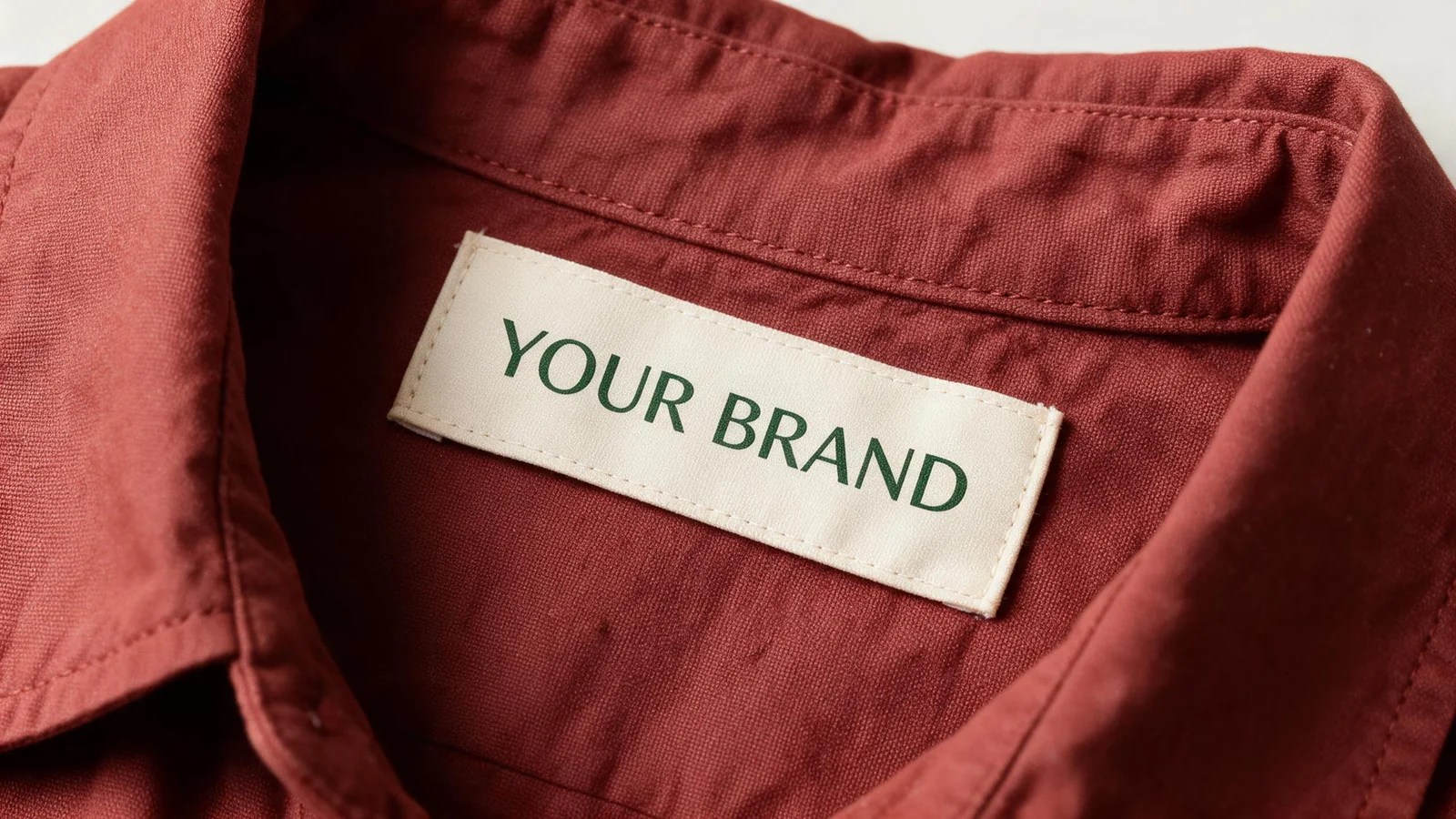
For the garment application, keep the name readable alongside the seam and any separate size or information label. Use the label-placement sample brief for attachment and position decisions. The brand wordmark is only one part of a label set; it does not establish which fiber, care, origin or responsible-party information a particular market requires.

A larger hangtag can carry a different layout without changing the approved spelling. Keep the source file and version visible in the production brief so a supplier does not retype the name from a screenshot. If a color, line break or letter shape changes, compare it with the master rather than approving it as an unrelated visual.
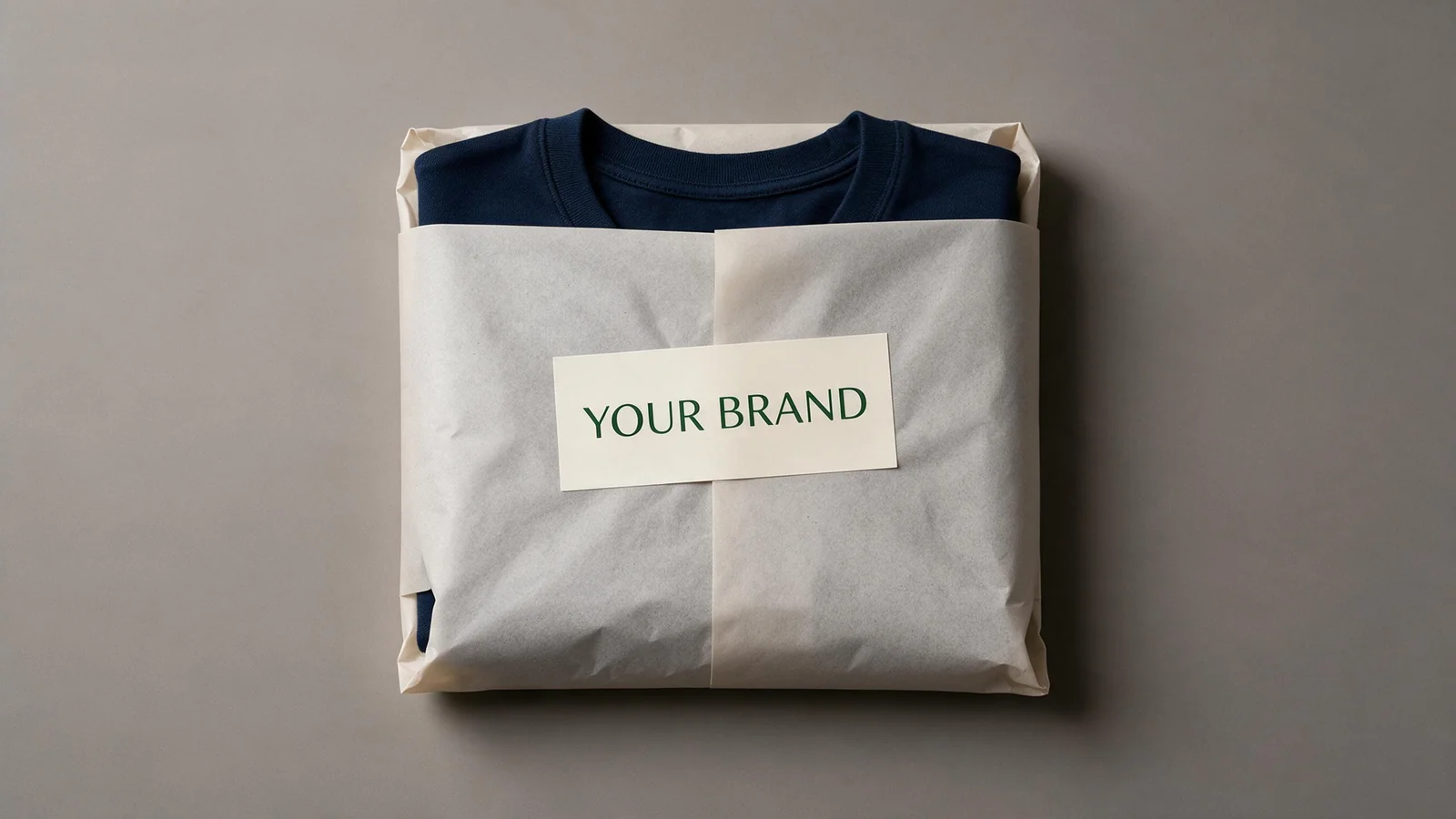
Packaging may come from a different supplier than the sewn label. Check its proof separately against the same artwork version. A match on one carrier does not confirm another carrier's color, reproduction or attachment. Request the evidence appropriate to each item and use the labels and packaging guide to organize the components.
6. Release one version to the supplier
Send a branding release that makes the next action unambiguous. Include the approved wording, artwork filename and revision, color references, intended carrier, finished size, attachment or fold areas and the proof required before production. List the person authorized to approve changes. Mark older files superseded instead of leaving multiple “final” files in circulation.
- Release artwork for proof: identify the item and version to be evaluated; do not label this as approval to manufacture the batch.
- Hold an unresolved item: state whether the issue is naming review, wording, reproduction, position or another specific requirement, and who must resolve it.
- Approve a defined production reference: retain the reviewed file and relevant physical proof, state which items the approval covers and record remaining conditions.
If the name changes, make a carrier list: sewn labels, hangtags, packaging, website text and other places where the old wording appears. Identify which items have only been designed, which have been ordered and which already exist. Ask for the cost and timing of the change before authorizing replacement work. This limits an avoidable mismatch between a revised logo file and trims already made.
For a development discussion, send GoVoloom your garment and branding brief, noting whether the name is provisional and which decisions remain open. Production scope and the required proofs are confirmed for the project. A supplier's artwork review evaluates the proposed application; it should not be treated as trademark clearance.
Questions before ordering branded labels
Can I choose the name because the domain is available?
Domain availability is one practical check. It does not grant trademark rights or settle conflicts with an existing clothing name. Record domain, business-name, profile and trademark findings separately, with the relevant market and date.
Can sampling start while the brand name is provisional?
Discuss which garment-development tasks can use a placeholder and explicitly hold final branded trims. Confirm how a later name change would affect proofs, costs and timing before authorizing production.
Does approving a label proof mean the name is cleared?
No. A proof can establish the wording, appearance and application you reviewed. It does not determine trademark availability. Keep the naming review and the manufacturing approval as separate records.
Source notes: the U.S. search example follows USPTO guidance on strong trademarks, confusion, federal and broader clearance searches, and the distinction between domain names and trademarks. WIPO guidance informs the limits of its Global Brand Database. Sources checked October 21, 2026. The decision record and supplier handoff are editorial workflow suggestions; no name-specific legal opinion or filing service is provided.